.png)
Press Release
Health Innovation Should Not Stop at Pilot Projects: CISDI Calls for Systemic Change at Leimena Conference 2026
CISDI Secretariat • 27 Juli 2026
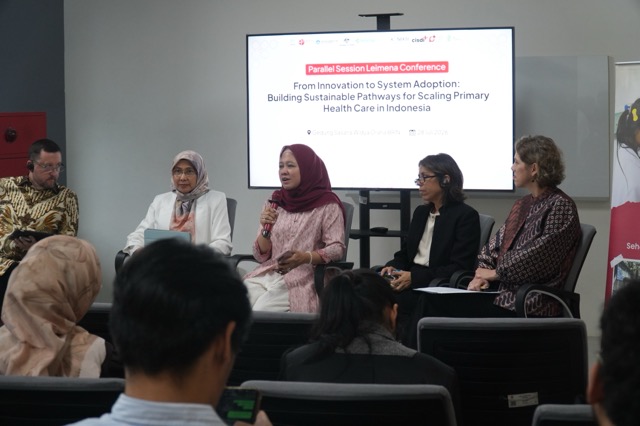
Jakarta, July 28, 2026 — The Center for Indonesia's Strategic Development Initiatives (CISDI), in partnership with the United Kingdom and Australia, is advocating for a stronger ecosystem that enables proven health innovations to be adopted into the national health system. This message was delivered during the plenary discussion, From Innovation to System Adoption: Building Pathways for Sustainable Primary Health Care Transformation in Indonesia, at Leimena Conference 2026 on Tuesday, 28 July 2026.
Founder and CEO of CISDI, Diah Satyani Saminarsih, said that innovations designed to strengthen primary health care—including digital health solutions, community-based interventions, and new models of service delivery—have grown significantly in recent years. Many of these innovations have demonstrated promising results in improving access, quality, and continuity of primary health care services.
"The challenge is that many health innovations never progress beyond the pilot stage. They are tested but never scaled or institutionalized. As a result, our national health system misses critical opportunities to drive meaningful structural transformation," Diah said.
Leimena Conference is one of Indonesia's leading annual forums on health systems and primary health care. Held from 27–29 July 2026, the conference brings together policymakers, researchers, practitioners, civil society organizations, professional associations, and development partners. More than 100 experts and academics participated in this year's conference, hosted at the PDDI BRIN Building in South Jakarta.
Leimena Conference 2026 featured four plenary sessions focusing on integrated primary health care models, the digitalization of Integrated Primary Health Care (ILP), sustainable financing for ILP, and strengthening the health workforce. The conference also included regional policy dialogues, parallel sessions, and an exhibition featuring 10 booths from community organizations and health development partners.
As part of the conference, CISDI convened a plenary discussion featuring representatives from Indonesia's Ministry of Health and KONEKSI (Knowledge Partnership Platform Australia–Indonesia) and the British Embassy Jakarta. The session brought together perspectives from government, program implementers, and international experts to explore practical pathways for advancing sustainable health system transformation.
Diah emphasized that health innovation should continue beyond the development stage until it reaches system adoption—the point at which innovations are produced at scale and generate benefits for the wider population. However, many promising innovations fail to reach this stage due to policy misalignment, insufficient evidence generation, fragmented regulations, and limited engagement of relevant stakeholders during the innovation process.
dr. Elvieda Sariwati, M. Epid, Director of Primary Health Care Governance at the Ministry of Health, emphasized that the government cannot achieve health transformation alone. She noted that collaboration across sectors is essential to generate and scale evidence-based innovations.
"Strong evidence is the key to ensuring that innovation moves beyond the pilot phase. The Ministry of Health's vision is to build an adaptive health ecosystem where scientifically proven innovations can be integrated into the national health system efficiently, equitably, and sustainably," dr. Elvieda said.
Jana Hertz, Team Leader at KONEKSI, highlighted the importance of multi-stakeholder collaboration in bridging the gap between innovation and adoption.
"The government provides leadership and policy direction, while researchers and academics contribute rigorous scientific methodologies. At the same time, civil society organizations and local communities play a crucial role in implementing research and innovation on the ground," Jana said.
Julia Takahashi-Robertson, Health Adviser and Head of the Health Team at the British Embassy Jakarta, shared the UK's experience in ensuring health innovations are translated into national policy.
“The United Kingdom’s experience shows that health innovation is most effective when supported by a clear and trusted pathway for assessment, testing, and adoption. Innovation succeeds when it operates within systems that ensure quality and safety, are grounded in strong evidence, assess value for money, respond to health system needs, and support scale-up. Through institutions such as the National Institute for Health and Care Excellence (NICE), the Medicines and Healthcare products Regulatory Agency (MHRA), and the National Health Service (NHS), including its Health Innovation Networks, promising innovations are assessed for safety, clinical effectiveness, cost-effectiveness, and real-world impact before being adopted into policy and practice. This demonstrates that successful Innovation is not simply about introducing new technologies. It also requires robust systems to generate and validate evidence, support informed decision-making, and ensure that innovations deliver better outcomes for patients and health systems.”
According to Diah, Indonesia's health transformation should not be measured solely by the number of pilot projects launched. Rather, its success should be assessed by how many evidence-based innovations are co-created, institutionalized, adopted into public policy, and ultimately improve health outcomes for communities across the country.
– END –
About CISDI
The Center for Indonesia's Strategic Development Initiatives (CISDI) is a center of expertise dedicated to advancing Indonesia's health sector and strengthening the national health system through evidence-informed policy, research, advocacy, and innovative interventions that are inclusive and participatory.
For More Information
CISDI Media Team
Phone: +62 851-1139-0040
Email: [email protected]
About KONEKSI
KONEKSI is the Australia–Indonesia Knowledge Partnership Platform that supports collaboration between organisations in both countries to generate inclusive and sustainable policy and innovation outcomes. Supported by the Governments of Australia and Indonesia, KONEKSI promotes equitable research partnerships and the use of knowledge to address complex development challenges.
About British Embassy Jakarta
The British Embassy Jakarta’s Digital Health Programme aims to strengthen Indonesia’s health system through support for digital health transformation, including the digital health transformation strategy and the regulatory sandbox for telemedicine; health workforce capacity development, including the MARCH project; and innovation to improve Indonesia’s genomics knowledge. Runs from 2021, the programme has contributed to more inclusive, accessible, and higher-quality public healthcare services.